
Emigrants leaving Europe by way of Rotterdam, 1908
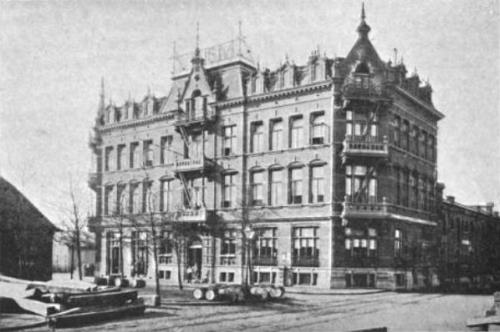
Photo: Hotel for Emigrants of the N.A.S.M.
Emigration, as will be readily understood, is most intimately connected with the economic state of European countries and of the nations to which the emigrants are going.
Up until 1908, emigrants, leaving by way of Rotterdam, are mostly bound for North America.
The ensuing figures will give an idea of the emigration during the last 14 years through 1906
Emigrants Leaving Europe via Rotterdam
| Years | Number of emigrants who took ship at Rotterdam | Number of those that passed through Rotterdam, but took ship elsewhere | Total |
|---|---|---|---|
| 1894 | 7,860 | 5,173 | 13,033 |
| 1895 | 9,931 | 4,212 | 14,143 |
| 1896 | 9,706 | 1,375 | 11,063 |
| 1897 | 5,972 | 1,033 | 7,005 |
| 1898 | 10,177 | 2,382 | 12,559 |
| 1899 | 13,985 | 4,977 | 18,962 |
| 1900 | 22,121 | 11,260 | 33,381 |
| 1901 | 22,300 | 10,605 | 32,905 |
| 1902 | 28,304 | 17,231 | 45,535 |
| 1903 | 32,657 | 20,173 | 52,835 |
| 1904 | 26,650 | 22,366 | 49,016 |
| 1905 | 40,836 | 14,738 | 55,574 |
| 1906 | 42,511 | 6,410 | 48,921 |
A board of control, appointed by H.M. the Queen, regularly supervise both the lodging houses where these poor people have to stay and the vessels that are to carry them. Definite rules have been laid down by Royal Decree for their lodgings on board ship. The board sees to it that these rules are carried out.
The Holland-America Line carries the more significant part of these emigrants.
Since 1893, this Company has had a hotel for emigrants, in the immediate neighborhood of its own quay, where a thousand persons can find shelter.
This excellent hotel, which comes up to the most exacting requirements of modern hygiene, has some barracks connected with it, where such persons as suffer from infectious diseases can be isolated, and emigrants coming from infected countries, can be kept in quarantine for some time.
The vast flow of Jewish emigrants from Romania and South Russia has given the Montefiore society, who try to alleviate the sufferings of Jewish fugitives, an occasion to build a shelter for these emigrants in this town. The Municipality has allowed the Society the use of a house belonging to them, free of charge.
Of late years, scarcely 5% of the emigrants are Dutch. In 1890 this percentage amounted to 20%.
Chapter 30, Emigrants, The Port of Rotterdam by Hendrik Albert van Ysselsteyn, C.E., Deputy-Director of the Department of Works at Rotterdam, Third Edition, 1908, Printed in Rotterdam by Nijgh & van Ditmar's Publishing Co., Pages 197-198

